


 Deutsch
 English
 Italiano







3D Printing in Aerospace
Lighter parts, complex geometries and faster development: additive manufacturing opens up new possibilities for the aerospace industry – with particularly high requirements for materials and qualification.In aerospace, 3D printing is used primarily where weight, complexity and short development times matter: for lightweight structures, parts with integrated cooling channels, cabin parts, brackets as well as prototypes and small batches. At the same time, the industry has particularly strict requirements for materials, processes, testing and qualification.
This page gives an overview of applications, benefits, challenges and relevant materials – and shows where you can find more information on processes and materials on protiq.com.
Applications
Where is 3D printing used in aerospace?
Typical applications include lightweight structures in spaceflight, cabin and cockpit parts, engine components, parts for helicopters and drones as well as heat exchangers. Prototypes, fixtures and spare parts needed in small quantities are also common.

Space
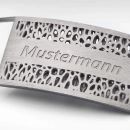
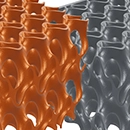
In spaceflight, every kilogram counts. Parts with internal lattice structures combine low material use with high strength and thus save mass.

Cabin and cockpit
Housings, panels, ventilation grilles and brackets can be precisely adapted to existing structures. Prototypes enable fast testing and short development cycles.

Engines
Engine components benefit from complex geometries and integrated cooling channels that are hardly possible with conventional methods – for example made of high-temperature nickel-based alloys.

Helicopters
Lightweight structural components and customized parts such as housings can be modified quickly and produced in small quantities.

Drones
Electronics housings, camera mounts and lightweight structural parts – with modular, interchangeable components, for example for inspection, logistics or aerial photography.

Thermal management
Heat exchangers with complex internal structures cool sensitive systems under high thermal loads. More about 3D-printed heat exchangers
Benefits
What are the benefits of 3D printing in aerospace?
The most important benefit is weight reduction: in aerospace, less mass means lower fuel consumption and greater range or payload. Design freedom, efficient use of material and shorter development times are further advantages.
Weight reduction
Topology-optimized parts and internal lattice structures save material and weight while maintaining function.
Complex geometries
Undercuts, cavities and integrated cooling channels can be realized in one part – several parts can be combined into one.
Faster development
Prototypes are made directly from 3D data, without tooling. Design changes are made in the 3D model, which shortens development and test cycles.
Efficient in small quantities
One-offs, small batches and spare parts can be produced without tooling costs – suited to the often low volumes in the industry.
Challenges
What are the challenges of 3D printing for aerospace?
The biggest challenges are the qualification of materials and processes, proving reliability and the limited part size. Parts must meet strict safety and performance standards – which requires extensive testing and specialist expertise.
- Qualification and reliability: Components are often exposed to extreme conditions. Materials, processes and parts must therefore be extensively tested and validated to rule out material defects or structural weaknesses.
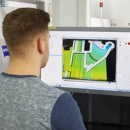
- Expertise: Design and production require in-depth knowledge of processes and material properties such as strength, temperature resistance and corrosion behavior – as well as of quality inspections, for example using computed tomography.
- Part size: Large structural components often do not fit into the build space of industrial 3D printers. If they are assembled from several parts, additional post-processing and assembly are required, and the joints must be taken into account in the design.
Materials
Which materials are relevant for aerospace?
Materials with a good strength-to-weight ratio or special temperature and fire resistance are in demand: aluminum and titanium alloys, nickel-based alloys such as Inconel, high-performance plastics such as PEEK and flame-retardant plastics.
| Material group | Properties | Typical use |
|---|---|---|
| Aluminum alloys | Low weight with high strength, good thermal conductivity, good corrosion resistance | Lightweight structural and housing parts, heat exchangers and heat sinks |
| Titanium alloys | Very high strength at low density, good corrosion resistance | Highly stressed lightweight components |
| Nickel-based alloys such as Inconel | High strength and oxidation resistance even at very high temperatures | Parts under high thermal loads, for example in engines |
| High-performance plastics such as PEEK | High strength and stiffness even at elevated temperatures, very good chemical resistance, much lighter than metals | Metal replacement for brackets, housings and cabin parts |
| Flame-retardant plastics such as PA12 FR | Flame-retardant, good breaking strength, resistant to many chemicals | Parts subject to fire protection requirements, for example in the cabin |
Which materials are suitable and approved for a specific application depends on the respective requirements. You can find an overview of materials for 3D printing here:
↑ Back to overviewOutlook
What role will 3D printing play in the future of spaceflight?
A major future topic is in-situ manufacturing: spacecraft or stations could print spare parts directly in orbit or on other celestial bodies in the future – independent of supplies from Earth.
This would increase the autonomy of long-term missions. The European Space Agency ESA has already investigated how structures for a lunar base could be printed from lunar dust (regolith). This is still research – but it shows how fundamentally additive processes could change spaceflight.
↑ Back to overview
Further information
You can find more about processes, materials and related applications on these pages:
Frequently asked questions about 3D printing in aerospace
What role does 3D printing play in aerospace?
3D printing enables lightweight, complex and high-performance parts that are difficult to produce conventionally. It is used primarily for lightweight structures, parts with integrated cooling channels, cabin parts, brackets as well as prototypes and small batches.
What are the benefits of 3D printing for aerospace applications?
The key benefits include weight reduction through lightweight design, the integration of complex geometries and functions into a single part, efficient use of material and shorter development times thanks to tool-free production.
Which materials are processed additively in aerospace?
Commonly cited materials include aluminum and titanium alloys, nickel-based alloys such as Inconel, high-performance plastics such as PEEK and flame-retardant plastics. Which material is suitable and approved depends on the specific application.
Why are qualification and testing so important?
Aerospace parts are often exposed to extreme conditions and must meet strict safety and performance standards. Materials, processes and parts are therefore extensively tested and validated to rule out material defects or structural weaknesses.
Why is additive manufacturing suitable for drones?
Drones benefit from lightweight and stable parts that enable long flight times. With 3D printing, housings, mounts and structural parts can be quickly adapted and built in a modular way – for example for inspection, logistics or aerial photography.
What significance does 3D printing have for future space missions?
A key future potential lies in in-situ manufacturing, where spare parts could be produced directly in space or on other celestial bodies. This would increase independence from supplies and make long-term missions easier.
↑ Back to overview